



OVERHEAD CRANE: TYPES, APPLICATIONS, AND HOW TO CHOOSE THE RIGHT ONE FOR YOU

The definition of a bridge crane and how it works
1.definition
Bridge cranes, also known as gantry cranes, are a common type of crane used in industrial settings. Their lifting devices are suspended on a traveling crane car, hoist, or boom crane that can move along the bridge frame. The bridge frame beams are directly supported on tracks through the running mechanism.
2.construction
A bridge crane is generally composed of a bridge (also known as the main girder), a main girder moving mechanism, a trolley equipped with a lifting mechanism, a control room, and an electrical system, etc.
The bridge frame is composed of the main beam, end beam, walkway, etc., and it is the basic component of a bridge crane.
A small vehicle, also known as a lifting small vehicle, is placed on the bridge frame guide rails and can move along the direction of the bridge. That is to say, for the bridge-type cranes in the workshop (factory), the small vehicle can move in the width direction of the workshop.
Bridge cranes mainly have operation methods such as driver's cabin operation, wired operation, wireless operation and multi-point operation.
The content is from Wikipedia. For more information, please click here“https://zh.wikipedia.org/wiki/overheadcrane”
Types of Overhead Cranes
For most industrial buyers, the choice comes down to two main configurations: single girder and double girder. Each is designed for different load capacities and operational demands.
1.Single Girder Overhead Crane
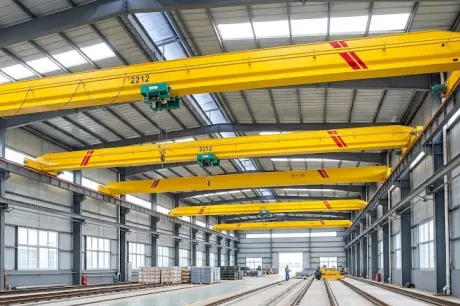
Single Girder Overhead Crane uses one bridge beam supported on two end trucks, with the hoist trolley running on the lower flange. It is lighter in structure, requires less headroom, and costs less to manufacture and install. This makes it the most economical choice for workshops handling loads up to 20 tonnes and spans up to 30 metres. Typical applications include manufacturing assembly lines, small warehouses, and maintenance bays.
2.Double Girder Overhead Crane
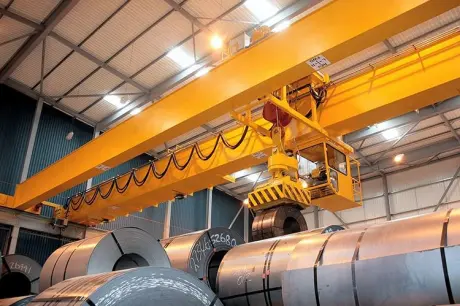
Double Girder Overhead Crane uses two parallel bridge beams with the hoist trolley running on rails mounted between them. This configuration provides superior rigidity and load distribution, making it the standard choice for heavy-duty applications — lifting over 10 tonnes and spanning beyond 25 metres. Common in steel mills, heavy machinery plants, and large-scale logistics centres.
3.European Standard Overhead Crane
European Standard Overhead Crane is designed to FEM/DIN European standards, featuring optimised single-girder or double-girder structures that significantly reduce deadweight and wheel loads compared to conventional designs. The lifting height is typically 20%–25% lower than a standard EOT crane, enabling more usable vertical space within the same building height. The wheel pressure can be 15%–20% smaller, and the hook approach is minimised — giving operators a larger effective working area.
Where Overhead Cranes Are Used
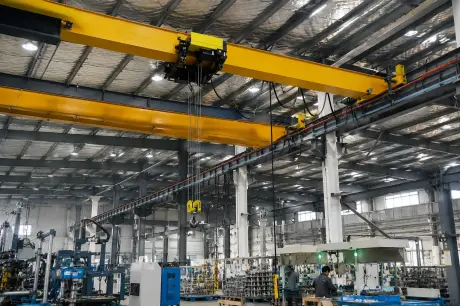
Overhead cranes are found across virtually every industrial sector. The most common applications include:
1.Manufacturing plants
moving raw materials, moulds, and finished products between workstations and assembly lines-
2.Warehouses and logistics centres
loading and unloading goods, pallet handling, and high-density storage-
3.Steel mills and paper plants
transporting heavy coils, plates, and paper rolls along fixed production paths-
4.Power stations and railway depots
equipment installation, turbine maintenance, and locomotive component handling
5.Hydropower stations and open yards
lifting gates and equipment in both indoor and outdoor environments-
How to Choose the Right Overhead Crane
Selecting the right overhead crane comes down to three practical questions.
1.What are you lifting, and how heavy is it?
The load weight directly determines whether you need a single girder or double girder crane
2.What is the span and lifting height?
The span is the distance between the two runway beams, and the lifting height is the maximum vertical distance the hook can travel
3.How often will you use it?
The work duty class — typically A3 to A7 under ISO standards — defines how many lifting cycles the crane is designed to handle per hour and per day.
Yuntian Overhead Crane Solutions
Yuntian Crane manufactures overhead cranes each crane is custom-engineered to the client's exact span, lifting height, and duty class requirements,You can click here "contact us" to let us know your requirements. Our technical team will provide you with a free customized solution that suits your needs.
HENAN YUNTIAN CRANE CO., LTD.
Email:sales@sgycranes.com
Website: [https://yuntiancrane.com/]
Whatsapp:+86-17337353108


