



WHAT IS A MARINE CRANE? A CLEAR GUIDE TO SHIP AND OFFSHORE CRANES
The definition of Marine Crane
Pick up almost any conversation with a ship operator, a port manager, or an offshore logistics coordinator, and at some stage they'll refer to a "marine crane." The label gets used broadly, but when people in the business use it, they usually mean one of two things: a deck crane mounted on a vessel to move cargo, or a heavier offshore crane designed for tougher open-water work. Understanding the difference—and knowing what's available—is what turns a long search into a useful shortlist.
So, what exactly is a marine crane?
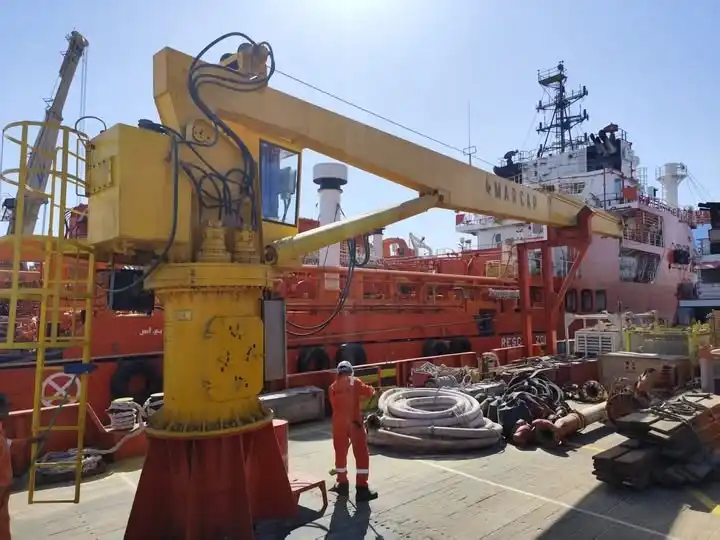
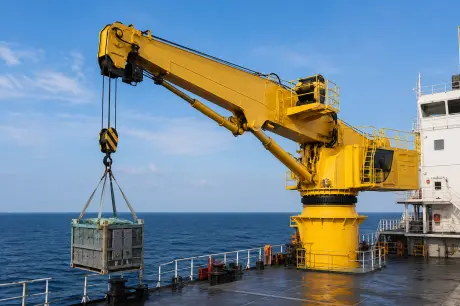
In simple terms, a marine crane is any lifting appliance built for installation on a ship, offshore platform, or floating structure. The International Organization for Standardization defines it under ISO 19355:2016 and ISO 21125:2019 as a crane specifically designed for marine environments, covering deck cranes on ships, floating cranes on barges, and provision cranes in engine rooms.
Unlike a land-based crane, a marine crane needs to operate on a moving surface—the vessel lists, waves shift the centre of gravity, and salt spray attacks everything. That means its design, materials, controls, and certification are all built around one reality: it must work reliably in conditions that land equipment never faces.
What Makes a Marine Crane Different
A marine crane isn't just a land crane bolted to a deck. The environment it works in shapes every aspect of its design.
1.Built for corrosion resistance from the start.
Saltwater is relentless. Marine cranes use multi-layer epoxy coatings, shot-blasted surface preparation, and stainless steel or chrome-plated components in critical areas—cylinder rods, fasteners, and electrical enclosures. Yuntian applies these corrosion protection measures across the entire Marine Crane product line.
2.Designed to work on a moving surface.
A factory overhead crane runs on fixed rails. A marine crane runs on a vessel that rolls, pitches, and heaves. The slewing ring, boom structure, and lifting mechanism must handle dynamic loads that change with every wave.
3.Compact footprint, maximum reach.
Deck space costs money. Marine cranes are designed with this trade-off in mind—telescopic booms retract into a minimal profile, knuckle booms fold down close to the deck, and even stiff boom cranes keep their pedestal footprint as small as possible.
4.Powered for independence.
A factory crane plugs into the grid. A marine crane often needs its own power source. Diesel-hydraulic drive is common on vessels where the crane operates independently. Electric drive is available where the vessel's power supply can support it. Some configurations offer both.
5.Certified to standards that matter.
Marine cranes follow classification society rules—CE, CCS, ABS, BV, and others. A crane cannot be installed on most commercially registered vessels without classification society approval covering its design, manufacturing, materials, and load testing.
6.Built for continuous operation in harsh conditions.
Marine cranes work at high duty cycles in salt spray, humidity, and temperature extremes. Sealed bearings, protected hydraulic systems, and weather-rated electrical enclosures keep the crane working when conditions turn rough.
The main types you'll see in the market
When someone starts looking for a marine crane, they quickly find that "marine crane" isn't a single product category. It's a group of different crane types, each designed for a specific set of tasks and space constraints on a vessel. Below are the six main configurations you'll encounter when researching marine lifting equipment.
1.Telescopic Boom Crane
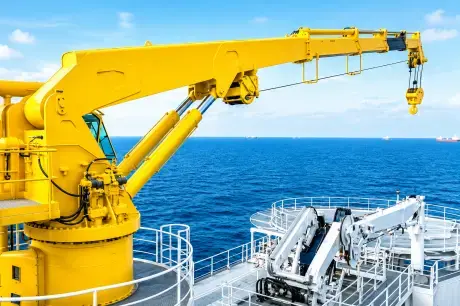
A telescopic boom crane uses a multi-section boom that extends and retracts hydraulically. The boom sections nest inside one another when retracted, giving the crane a compact footprint that frees up deck space during transit. When extended, the boom delivers the reach needed for cargo transfers between vessels or between ship and shore.
This combination of compact stowage and long working reach makes telescopic boom cranes a common choice on platform supply vessels, where deck space is at a premium. Yuntian offers the Marine Telescopic Boom Crane specifically engineered for this kind of work—designed to retract neatly when not in use and extend smoothly when the job starts.
2.Knuckle Boom Crane
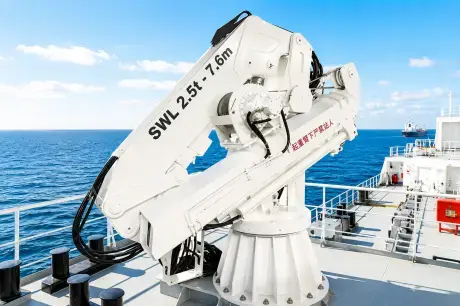
Knuckle boom cranes, sometimes called folding boom cranes, use an articulated arm with one or more knuckle joints that allow the boom to fold inward. When fully folded, the crane sits close to the deck, keeping the vessel's profile low and the working area clear. When unfolded, it delivers strong lifting capacity at short to medium radii.
This folding design is especially useful on offshore support vessels and any ship where overhead clearance matters. Yuntian's Marine Knuckle Boom Crane is built for these applications, offering the flexibility of a folding arm with the lifting capacity needed for serious cargo work.
3.Stiff Boom Crane
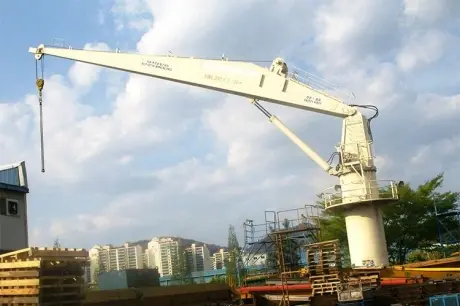
Stiff boom cranes, also referred to as rigid boom cranes, use a simple straight boom with hydraulic luffing and slewing. There are no telescoping sections and no folding joints—just a solid, welded box-section boom that moves up and down through a hydraulic cylinder and rotates on a slewing ring.
What makes a stiff boom crane worth considering is its mechanical simplicity. Fewer moving parts mean fewer points of failure, lower maintenance requirements, and a lift cycle that operators find predictable and easy to control. On vessels with adequate deck clearance, a stiff boom crane is often the most cost-effective long-term choice. Yuntian's Marine Stiff Boom Crane is designed for exactly this kind of straightforward, heavy-duty cargo handling.
4.Cargo Deck Crane
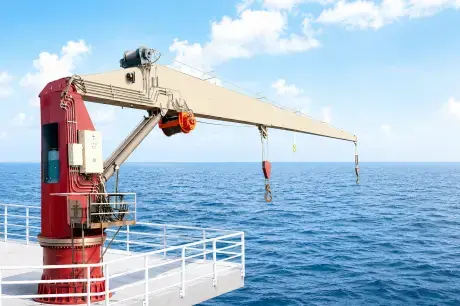
Cargo deck cranes are the workhorses of shipboard lifting. Pedestal-mounted on the vessel's deck, they provide 360-degree continuous slewing and handle the widest variety of loads—general cargo, containers, equipment, and supplies—between ship and shore or between vessels at anchor.
These cranes are designed for efficient, repetitive cargo handling in harbour and coastal conditions. Their pedestal base houses the hydraulic power unit and control systems, keeping the deck footprint compact. Yuntian's Marine Cargo Deck Crane is designed precisely for this all-purpose shipboard lifting, with configurations available to match different vessel sizes and cargo profiles.
5.Hatch Cover Gantry Crane
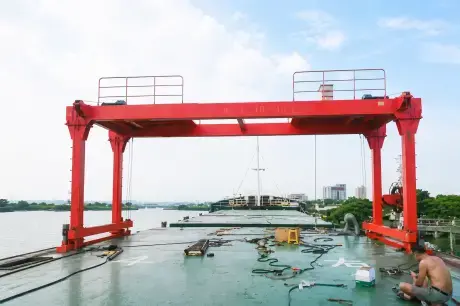
Hatch cover gantry cranes belong to a specialised category used mainly on bulk carriers and container ships. Their job is specific: lifting and repositioning heavy hatch cover panels across the vessel's deck, opening and closing cargo holds for loading and unloading.
Unlike pedestal-mounted deck cranes, hatch cover gantry cranes run on rails installed along the ship's deck. They use dual winch systems at both ends of the main beam, with four-point synchronized lifting to keep hatch panels level during movement. This rail-mounted gantry design makes them purpose-built for a single critical task—one that directly affects a vessel's turnaround time in port. Yuntian's Marine Hatch Cover Gantry Crane is engineered for this specific application.
6.Offshore Crane
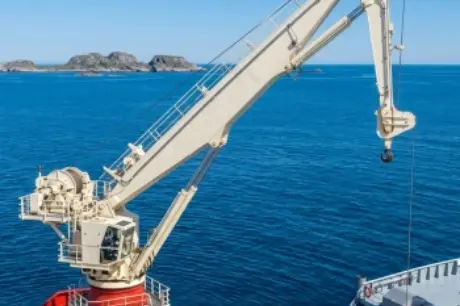
Offshore cranes are designed for the most demanding marine environments—open ocean, not sheltered harbour conditions. Installed on offshore platforms, FPSOs, or specialised offshore support vessels, these cranes face constant wave motion, high winds, and corrosive salt spray. Their design, materials, and certification requirements are correspondingly more rigorous than those of standard shipboard cranes.
Offshore cranes are typically built for higher duty cycles and may include advanced features such as active heave compensation, which counteracts vessel movement to keep the load stable during lifting. Yuntian's Offshore Crane is engineered to meet these strict offshore standards, with configurations available for platform, FPSO, and specialised vessel installations.
What should you know before choosing one?
The right crane depends first on where the equipment will work. A crane handling cargo in a sheltered port faces different demands from one operating on an open-ocean platform where wave motion, wind, and the need for precise load positioning all come into play. This operational context shapes the structural requirements, control systems, and safety features of the crane.
The second factor is what the crane needs to lift. Weight, dimensions, and the frequency of lifts all influence the crane's capacity, duty cycle, and configuration. A crane moving pallets at anchor has a very different workload from one handling subsea equipment or large structural components. Alongside this, the available deck space must be considered. On a tight deck, a knuckle or telescopic boom that stows compactly may be the only practical choice.
Finally, certifications matter. Reputable marine crane manufacturers provide documentation from classification societies such as CE, CCS, ABS, and BV. These certifications ensure that the crane has been designed, manufactured, and tested to recognised international standards. Without proper certification, a crane cannot be legally installed on most commercially registered vessels.
If you want to know how to choose the right Marine crane for you, you can click "contact us" to tell us your requirements. We will design the most suitable Marine crane for you.
How Yuntian approaches marine crane manufacturing
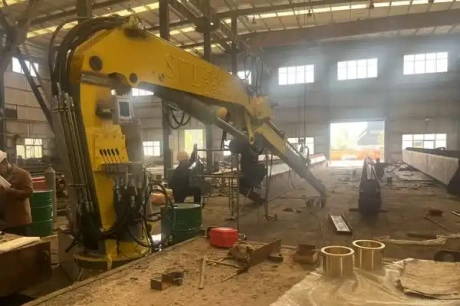
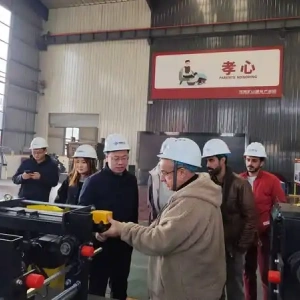
Yuntian Crane is based in Xinxiang, China—a region that supplies a significant share of the global crane industry. The company specialises in manufacturing and exporting marine cranes, overhead cranes, portal cranes, and port equipment, with products shipped to over 100 countries.
What this means for a buyer: Yuntian's Marine Crane product line includes telescopic boom cranes, knuckle boom cranes, stiff boom cranes, cargo deck cranes, hatch cover gantry cranes, and offshore cranes. Each crane is engineered to client specifications—span, capacity, lifting height, and duty rating are configured per project, not picked from a stock list.
If you need a marine crane and want to discuss specifications, contact the Yuntian engineering team. They'll ask about your vessel type, what you need to lift, and where the crane will operate. From there, they'll provide a specification and quotation within a working day.Our services and our team will definitely make you feel professional and authoritative.
Click here "case" to learn about our real case solutions for cranes.
Frequently Asked Questions
What is a marine crane, and how is it different from a standard industrial crane?
The label covers a lot of ground. When people in shipping and offshore work say "marine crane," they usually mean either a ship crane mounted on a vessel's deck for cargo handling, or a heavier offshore crane built for open-ocean platform work — the two have meaningfully different structural and certification requirements.
What separates both from a standard industrial crane isn't just the environment. A marine deck crane must operate on a moving surface, in salt spray that attacks steel and hydraulics every day, and it must carry classification society certification — CE, ABS, CCS, BV — before it can be legally installed on a commercially registered vessel. You can't take a factory crane, bolt it to a deck, and call it a marine crane.
What are the main types of marine cranes, and which suits my vessel?
There are six configurations you'll encounter when sourcing marine lifting equipment: telescopic boom crane, knuckle boom crane, stiff boom crane, cargo deck crane, hatch cover gantry crane, and offshore crane.
The right choice comes down to deck space and what you're lifting. If space is tight — as on most platform supply vessels — a telescopic boom crane or knuckle boom crane makes sense because both stow compactly in transit. For straightforward, repetitive shipboard cargo handling in harbour conditions, a stiff boom crane is simpler mechanically and cheaper to maintain. Hatch cover gantry cranes are purpose-built for bulk carriers that need to open and close hold panels quickly in port. Offshore cranes are a different category entirely — higher duty cycles, stricter certification, and often active heave compensation for open-ocean work.
Which certifications does a marine crane need, and does it depend on where the vessel operates?
Yes, and this is one of the most overlooked parts of the marine crane specification process. ABS certification is standard for US-flagged vessels and American offshore operators. CCS covers Chinese-registered ships. BV and DNV come up frequently with European operators and certain African port authorities. Some projects require multiple certifications — a vessel operating internationally may need both CE and ABS documentation.
Confirm with your vessel's flag state authority which classification society certificates are required before ordering. A certified marine crane that doesn't match the flag state requirement can't be commissioned, regardless of build quality.
What lead time should I plan for when ordering a marine crane?
For a standard marine cargo deck crane or telescopic boom crane in a common capacity range, production typically runs 8 to 12 weeks from order confirmation, plus shipping. Custom marine crane builds — non-standard capacities, specific boom configurations, or cranes requiring classification society factory surveys — take longer. The survey process adds time because the inspector must attend at specific production milestones, not just final inspection. If you're working to a vessel drydock or commissioning schedule, confirm lead time before signing the purchase order.
Can a marine crane be retrofitted to an existing vessel?
Retrofitting is common — many vessels upgrade ship deck cranes mid-service life rather than specifying them during the original build. The practical requirements are a mounting point that handles the crane's footprint and dynamic loads, a matching power supply, and enough clear deck area for safe operation. For a marine crane installation on an existing vessel, the manufacturer typically needs the deck drawings and a structural assessment before confirming whether reinforcement work is needed.
How do you maintain a marine crane in a high-corrosion coastal or offshore environment?
The coating system is the foundation — marine crane corrosion protection starts with multi-layer epoxy applied over shot-blasted steel, with stainless steel or chrome-plated components in exposed areas like cylinder rods and fasteners. Beyond that, the maintenance focus is on hydraulic circuit integrity, scheduled bearing regreasing, and keeping electrical enclosure seals intact so salt moisture doesn't reach the control components.
A marine crane for offshore use that's correctly specified and maintained on schedule should run for years without structural corrosion failures. Problems tend to appear on cranes that were underspecified for their actual working environment — a coastal harbour crane deployed on an open-ocean platform, for example — rather than on equipment that was correctly matched to the application from the start.
HENAN YUNTIAN CRANE CO., LTD.
Email:sales@sgycranes.com
Website: [https://yuntiancrane.com/]
Whatsapp:+86-17337353108


