



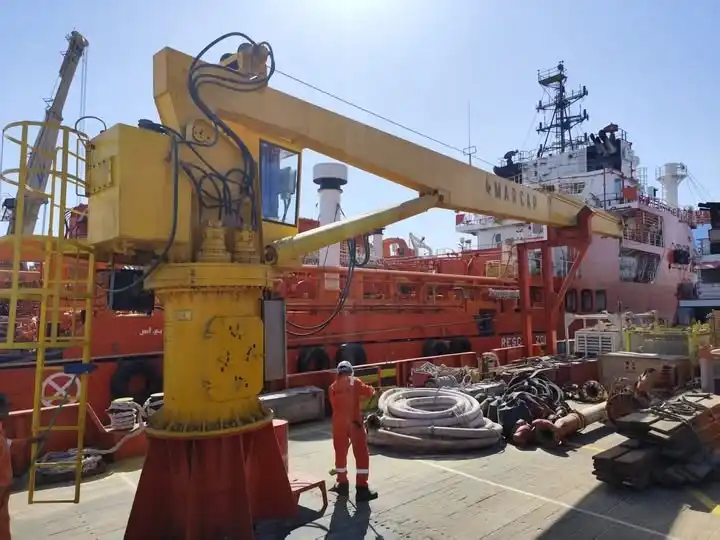
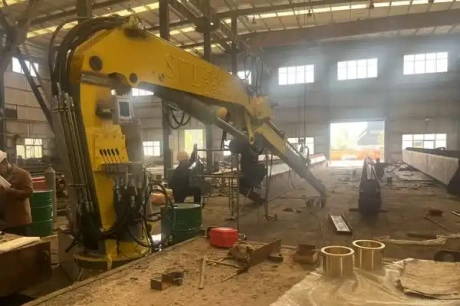
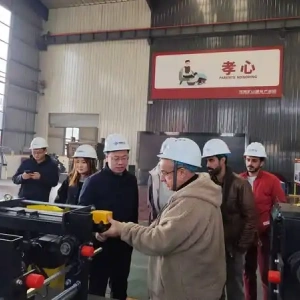
PORTAL CRANE TYPES: SINGLE JIB, FOUR LINK, AND MOBILE HARBOUR SOLUTIONS
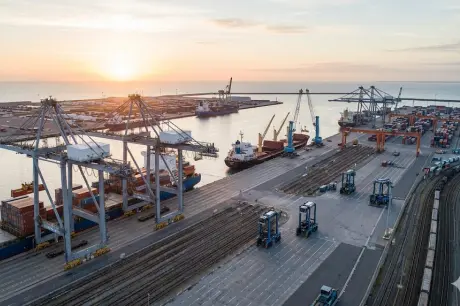
The definition of a portal crane
A portal crane is a rail-mounted slewing crane whose gantry structure forms a door-like frame. It is one of the most widely used machines in ports, shipyards, and heavy industrial operations. Unlike a gantry crane that moves loads linearly, a portal crane features a rotating jib that covers a circular working area — typically 360 degrees — enabling it to reach across a vessel's deck, pick up cargo, and place it precisely onto trucks, conveyors, or storage yards, all from a single quay position.
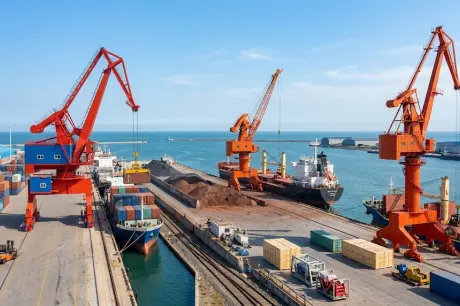
Single Jib Portal Crane
The Single Jib Portal Crane uses a single rigid boom with wire-rope or rack-and-pinion luffing — the simplest and most cost-effective configuration in the portal crane family.

Key characteristics:
1.Lighter deadweight and smaller wheel pressure
reduces quay infrastructure investment, making it an economical choice for small and medium-sized ports handling bulk material
2.360-degree full slewing
provides extensive operational coverage from a fixed quay position
3.Quick hoist attachment change
switching between hook, grab, and container spreader takes only minutes
Single jib portal cranes are widely used in ports, terminals, shipyards, and steel mills, with lifting capacities ranging from 5 to over 650 tonnes using a hook and working radii extending to 75 metres.
Four Link Portal Crane
The Four Link Portal Crane employs an optimized combined jib system — a four-bar linkage mechanism consisting of the main boom, fly jib, and tension rods.
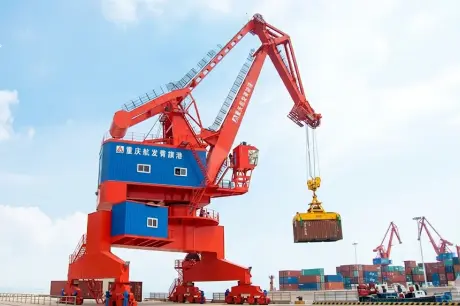
Where it excels:
1.Level luffing
the load moves horizontally during boom luffing, minimising energy consumption and improving operator efficiency-
2.Higher lifting capacities and wider radii
designed to handle larger vessels with heavier cargo at comprehensive multi-cargo terminals
3.Smooth, precise load handling
the balanced linkage mechanism provides operational stability that a single rigid boom cannot match
With a 360-degree rotation, PLC control, and AC frequency conversion speed regulation, the four link portal crane handles containers, bulk cargo, sundries, and general cargo efficiently.
Mobile Harbour Crane
The Mobile Harbour Crane (MHC) is a rubber-tyred, self-propelled variant that requires no fixed rails. It combines the slewing capability of a portal crane with the mobility of a wheeled vehicle, making it one of the most flexible pieces of port handling equipment available today.
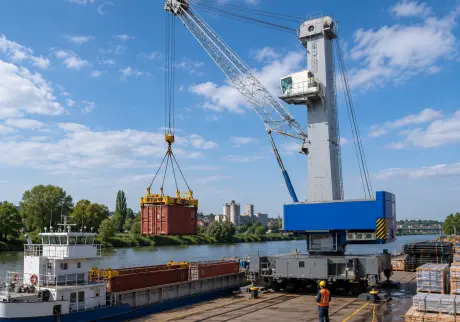
What sets it apart:
1.Track-free mobility
rubber tyres allow the crane to relocate between berths or terminals without infrastructure changes
2.Rapid multi-berth deployment
can serve several vessels along the quay in a single shift
3.Versatile attachment compatibility
hook, grab, and container spreader options make it adaptable to bulk, general cargo, and container operations
Mobile harbour cranes are widely used in small to medium-sized ports and multi-purpose terminals that require operational flexibility. They are equipped with intelligent control systems — including anti-sway technology and load monitoring — to ensure precise lifting, and feature corrosion-resistant, marine-grade protective coatings for harsh coastal environments.

Choosing the Right Portal Crane
The decision between a single jib, four link, and mobile harbour crane depends primarily on the port's operational model and infrastructure.
1.For small to medium ports
focused on bulk and general cargo with limited quay infrastructure, a single jib portal crane offers the fastest return on investment.
2.For large multi-cargo terminals
handling heavy container, bulk, and project cargo, a four link portal crane provides the level-luffing precision and heavy-lift capability required.
3.Special place
For terminals requiring flexible, multi-berth operations or ports without existing rail infrastructure, a mobile harbour crane eliminates the need for fixed rail installation entirely.
For help selecting the right configuration for your site, get in touch with "our team" through the "Contact Us" page — we typically respond within 24 hours.
If you are evaluating which portal crane configuration best fits your terminal or shipyard, reviewing real-world installations often helps clarify the decision. Our "Case Studies" page documents a range of completed projects — from single jib cranes handling bulk cargo at regional ports to four link cranes operating at multi-purpose terminals. Every crane we deliver is supported by the global "Service & Support" team, covering installation, commissioning, operator training, and long-term maintenance.
HENAN YUNTIAN CRANE CO., LTD.
Email:sales@sgycranes.com
Website: [https://yuntiancrane.com/]
Whatsapp:+86-17337353108


