



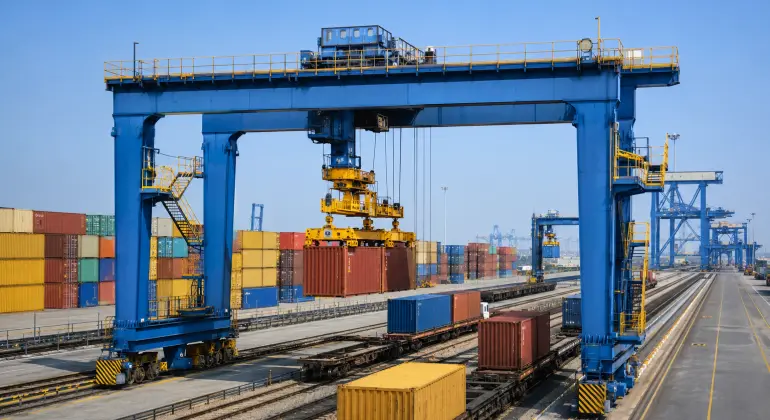
YUNTIAN RMG CRANES AT A CONTAINER TERMINAL IN MUNDRA, INDIA
Background
A container terminal operator in Mundra, India, was constructing a greenfield terminal on the Gujarat coastline, designed from day one with rail handling integrated into yard operations. The ambition was straightforward: build a facility where containers could move seamlessly from vessel to stack to train without the typical yard–rail disconnect that slows down inland distribution. Rail connections aren't a retrofit here — they are the backbone of the terminal's operating model.
The Challenge
The terminal had already committed to 30 rubber-tyred gantry cranes to form the core of their yard stacking operations. But RTGs, for all their flexibility across stacking blocks, aren't built for the rhythm and precision that rail loading demands.
Train loading windows are tight. Container alignment needs to be accurate. Misalignment during a rail move can cause delays, damage claims, and safety risks. The terminal needed cranes capable of working fixed rail corridors with repeatable precision — loading and unloading trains that run between the coast and inland regions of northern India.
They also needed to synchronise the rail interface with the yard stacks managed by the RTG fleet. Without that synchronisation, you get congestion. Bottlenecks. The rail ramp becomes a choke point instead of a throughput accelerator.
The Solution
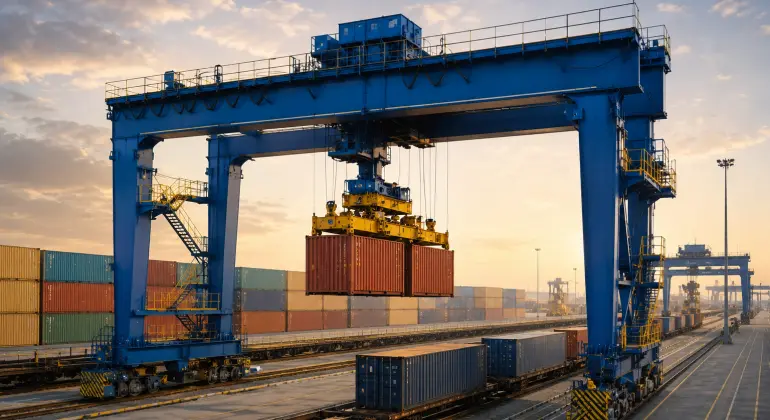
Two Yuntian rail-mounted gantry cranes were ordered for the terminal, each equipped with a twin-lift spreader and a rotating trolley. The rotating trolley allows the operator to achieve precise container alignment during rail moves, which is especially useful when working across different train configurations and tight loading windows. The twin-lift capability means each crane can handle two 20-foot containers simultaneously, significantly improving throughput.
An Active Load Control system was specified to eliminate container sway during positioning. In practice, this means the spreader stays steady, the container goes exactly where it should, and the operator isn't fighting pendulum motion that burns time and raises safety risks.
Yuntian's RMGs were designed for high-density stacking in container terminals, powered by fully electric drives. The electric drive system delivers energy savings compared to diesel alternatives, and the cranes run with zero onsite emissions.
Key Advantages
1.Twin-lift spreader and rotating trolley enable precise container alignment during rail operations
2.Active Load Control eliminates container sway, improving placement accuracy and safety
3.Fully electric drive for zero onsite emissions and lower energy costs
4.Purpose-designed for fixed rail corridor operations with repeatable precision
5.Smooth synchronisation between rail interface and yard stacks
The Result
The RMG cranes were fully operational and handling train loading and unloading duties, synchronising the flow of containers between the terminal's coastal location and inland regions. The combination of RTGs managing the yard stacks and RMGs handling the rail interface allowed the terminal to smooth out container inflow and outflow by rail, aligned with yard stack activity. The terminal operator, satisfied with the equipment's performance and the way it integrated into their broader yard-and-rail system, continued expanding the terminal's rail capacity.
HENAN YUNTIAN CRANE CO., LTD.
Email: sales@sgycranes.com
Website: [https://yuntiancrane.com]
Whatsapp:+86-17337353108


