


WHY SHIPYARDS ARE RETHINKING THE GANTRY CRANE — FROM 900 TONNES TO 1,600 TONNES AND BEYOND
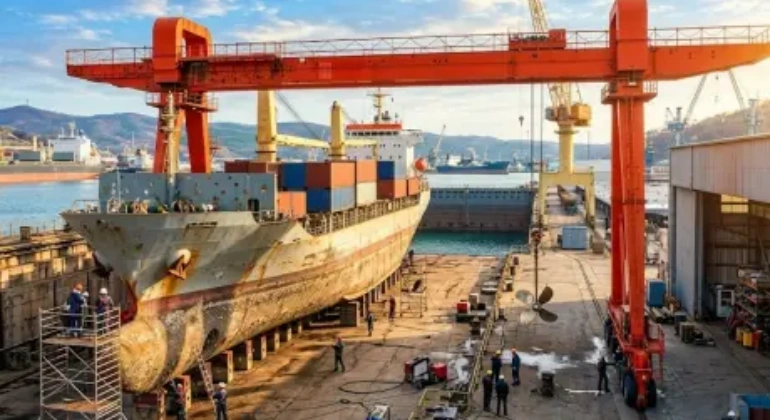
The orderbook speaks for itself. In 2024, Clarksons logged a record 8.3 million TEU in container ship orders. Chinese yards are booked through 2028. Hudong-Zhonghua just delivered the world's first 24,000 TEU LNG dual-fuel vessel — 399m long, 61.3m wide. Hengli Shipbuilding is signing roughly one order every three days, targeting 160 deliveries in 2028.
Behind every one of those deliveries is a shipbuilding gantry crane. And the cranes from ten years ago? They just don't cut it anymore.
The Capacity Crunch: Why 900-Tonne Lifts Aren't Enough
Ships Got Bigger. Cranes Didn't Keep Up.
That 24,000 TEU vessel? It required hull block assembly on a scale that didn't exist a decade ago. A single modern bow section can weigh over 1,000 tonnes. LNG cargo modules bring complex geometry and alignment tolerances so tight you'd sweat.
As experts put it: "We've got bigger ships and shorter build times." But shorter times don't happen by magic — you need cranes that handle bigger blocks in fewer lifts, precisely.
The Blind Spot Problem
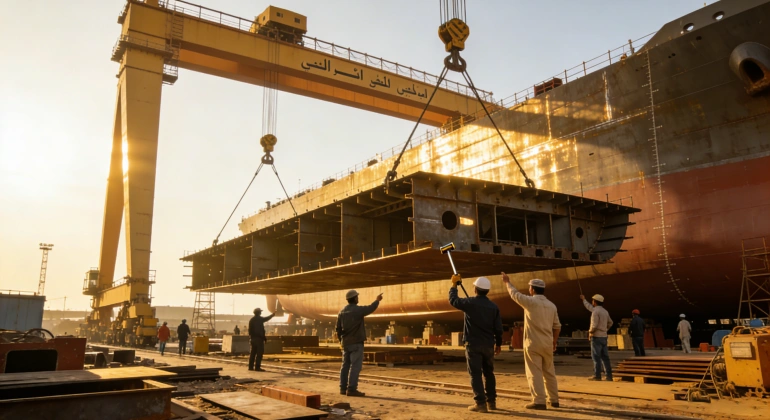
Here's what doesn't show up on any spec sheet: the blind spot. A 1,200-tonne block suspended 50m up — the operator can't see the bottom, the alignment pins, or the guys guiding it onto the hull. Everything runs on hand signals and radio. Final alignment tolerances are measured in millimetres and seconds. A 900-tonne crane needing multiple re-hooks just makes this worse every cycle.
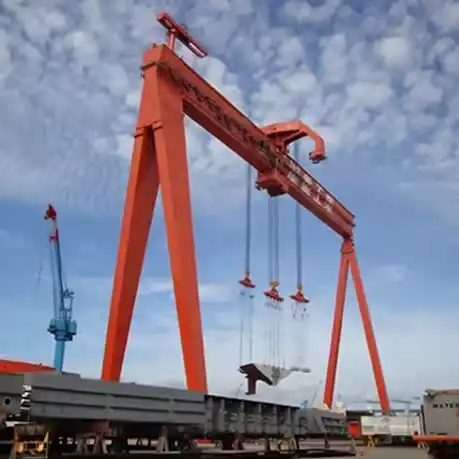
Tech Behind the Lift: 1,600-Tonne Goliath Crane, Dual Trolleys, 50 Metres High
Why 1,600 Tonnes Became the New Floor
1.New Times Shipbuilding put a 1,600-tonne × 229m dry dock gantry crane in Dock No. 4 — along with a 1,000-tonne unit. Both single-girder, heavy-duty, long-span. That 1,600-tonne figure isn't random — it matches the actual heaviest blocks being built in Chinese and Korean yards right now.
2.Hengli's already building three massive cranes, including two 2,000-tonne units with a record 256m span. Not vanity specs — they need this to build VLCCs, 20,000+ TEU ships, and LNG carriers from the same dock.
The Dual Trolley Shipbuilding Crane Difference
The real game-changer: dual-trolley system — upper and lower trolleys on the same structure, moving independently or in sync.
It kills the most time-wasting step: aerial rotation. A 1,200-tonne bow section arrives flat, needs to go vertical. With a single-trolley crane, you set it down, re-rig, lift again — eats half a day. With dual-trolley, the upper trolley holds the load, the lower applies controlled lateral force, and the block rotates mid-air. PLC and variable frequency systems sync the trolleys to within ≤3mm. That 3mm decides whether a hull section welds clean or needs costly rework.
Surviving Typhoon Season: Shipyard Gantry Crane Typhoon Resistance on the Coast
The Real Working Environment
1.Every major shipbuilding cluster sits on the coast — Jiangsu faces the Yellow Sea, Geoje faces the Korea Strait. Docks are there, and so are typhoons.
2.These cranes must survive 55 m/s winds (Category 16 typhoon, basically a Cat 3 hurricane) when idle, and stay operational up to 20 m/s. A 70m-tall, 229m-span crane fighting that? Serious engineering.
Four-Layer Storm Anchoring
Wind clamps, rail clamps, mooring lines, and ground anchors — four layers working in sequence. Anemometer triggers alerts, clamps lock the wheels, mooring lines hold against uplift. Everything's logged for insurance and post-storm checks.
Salt Corrosion: C5-M Coating and 1,000 Hours of Testing
Triple anti-corrosion process: shot blast, epoxy primer, fluorocarbon topcoat. Over 1,000 hours in salt spray testing — that's ISO 12944 C5-M, same standard as offshore oil platforms. Fluorocarbon beats polyurethane on UV and salt resistance. A 25–30 year coastal crane will get repainted — but good initial specs mean you do it less often.

From Months to Weeks: The Real Productivity Jump
What the Numbers Say
Dual trolley shipbuilding cranes boost efficiency by over 35% versus traditional equipment.
In practice: a 1,200-tonne bow section that used to take three days — set down, re-rig, re-lift, re-rig again — now rotates and positions in one continuous operation. Each re-rig cycle in a busy dry dock adds 6–8 hours of dead time.
The Compounding Effect
A modern container ship has 40–60 major hull blocks. Save one re-rig per block, and you're looking at hundreds of hours saved per hull. Clarksons revised 2024 container orders up 74%. Yards that build faster without expanding docks win those orders. The rest lose berth slots.
What's Next: Beyond the Traditional Crane
Shipbuilding Crane Digital Twin Is Already Here
1.The global digital shipyard market hit $3.19B in 2025, headed to $12.89B by 2033 (19.1% CAGR). 72% of shipbuilders report higher productivity with digital twins. 54% are investing in IoT sensors.
2.For cranes, digital twin means real-time mirroring of load, wire tension, trolley position, motor temp — anomalies get flagged before they become failures. A wire rope showing early fatigue? You replace it on schedule, not mid-lift.
Remote Operation Kills the Blind Spot
Heavy-duty shipyard gantry cranes are increasingly remote-controlled, giving operators better views of large assemblies. AI and machine vision are pushing toward full autonomy.
Remote operation directly solves that blind spot problem — multiple camera feeds cover the block bottom, alignment pins, and receiving hull. The operator sees everything the spotters see, simultaneously, no radio lag.
Energy Regeneration: The Green Crane
Modern gantry crane drives now recover energy during lowering and feed it back to the grid. A 1,600-tonne crane dropping a block from 50m generates serious potential energy — capturing it saves money and matches the carbon commitments shipowners like Hapag-Lloyd, CMA CGM, and MSC are writing into contracts.
68% of shipbuilders have adopted digital transformation strategies. The next-gen crane won't just be spec'd for capacity and span — it'll be spec'd for digital integration, energy regeneration, and remote operation readiness.
If you're evaluating a shipbuilding gantry crane — dry dock expansion, new berth, or capacity upgrade — send us your dock dimensions, max block weight, and required span. We'll confirm the configuration, dual-trolley sync spec, and C5-M corrosion grade that fits your build programme.


